Difference between revisions of "In-game Feedback"
ValterAlves (Talk | contribs) m |
ValterAlves (Talk | contribs) m |
||
| Line 28: | Line 28: | ||
| ex4=<mt p="InGameFeedback" g="Rhythm Paradise" h="200"></mt> | | ex4=<mt p="InGameFeedback" g="Rhythm Paradise" h="200"></mt> | ||
| ex5=<mt p="InGameFeedback" g="Patapon" h="140"></mt> | | ex5=<mt p="InGameFeedback" g="Patapon" h="140"></mt> | ||
| − | | ex6=<mt p="InGameFeedback" g="Ocarina Of Time" altg="Ocarina of Time" h="188"></mt> | + | | ex6=<mt p="InGameFeedback" g="Ocarina Of Time" altg="The Legend of Zelda:Ocarina of Time" h="188"></mt> |
| + | |||
}} | }} | ||
Revision as of 18:13, 12 September 2011

|

| |
| The card's front face | The card's back face |
Contents
Synopsis
| In-game feedback on sound input performance. |
Relationships
Contexts:
Sound Input  , Awareness
  , Emotional Script
  .
.
Less frequent context:
Play the Beat File:M385px-PlayTheBeat-front-v20.png.
Relates to:
Levelled Performance  .
.
Description
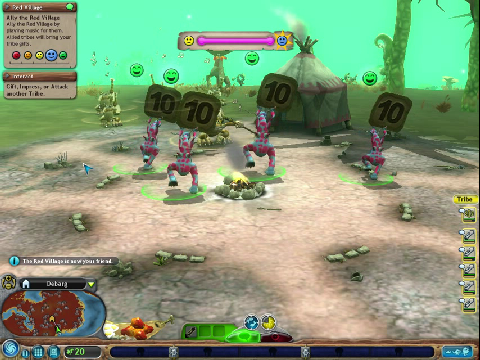
Gameplay based on Sound Input or on any other form of auditory performance may introduce unfamiliar challenges to players. One interesting approach to deal with them is to provide in-game (diegetic) feedback and assistance.
In some examples this feedback promotes positive emotions, which: a) contributes to balance the distress of unachievement, b) favors cognition by maintaining the player in a positive mood, and c) provides an additional source of entertainment.
A complementary way to tackle complexity is to require Levelled Performance regarding sound performance, in the same manner as it is done with other gameplay aspects.
Examples
    |
 |
 |
 |
 |
 |


