Difference between revisions of "In-game Feedback"
ValterAlves (Talk | contribs) m |
ValterAlves (Talk | contribs) m |
||
| Line 16: | Line 16: | ||
| revisions =Introduced in version 1.0 | | revisions =Introduced in version 1.0 | ||
| description= | | description= | ||
| − | [[Gameplay]] | + | [[Gameplay]] based on [[Sound Input]] or any other form of auditory performance may introduce unfamiliar challenges to players. One interesting approach to deal with them is to provide in-game (diegetic) feedback and assistance. |
In some examples this feedback promotes '''positive''' emotions, which: a) contributes to balance the distress of unachievement, b) favors cognition by maintain the player in a positive mood, and c) provides an additional source of entertaining. | In some examples this feedback promotes '''positive''' emotions, which: a) contributes to balance the distress of unachievement, b) favors cognition by maintain the player in a positive mood, and c) provides an additional source of entertaining. | ||
Revision as of 15:48, 17 August 2011

|

| |
| The card's front face | The card's back face |
Contents
Synopsis
| In-game feedback on sound input performance. |
Relationships
Contexts:
Sound Input  , Awareness
  , Emotional Script
  .
.
Less frequent context:
Play the Beat File:M385px-PlayTheBeat-front-v20.png.
Relates to:
Levelled Performance  .
.
Description
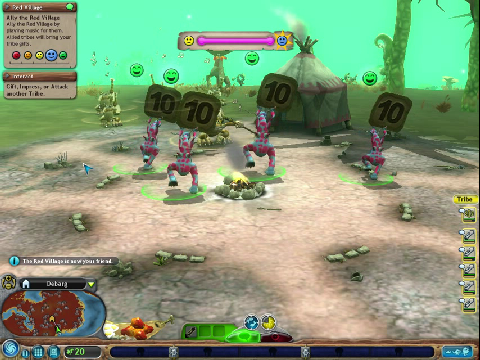
Gameplay based on Sound Input or any other form of auditory performance may introduce unfamiliar challenges to players. One interesting approach to deal with them is to provide in-game (diegetic) feedback and assistance.
In some examples this feedback promotes positive emotions, which: a) contributes to balance the distress of unachievement, b) favors cognition by maintain the player in a positive mood, and c) provides an additional source of entertaining.
A complementary way to tackle complexity is to require Levelled Performance regarding sound performance, in the same manner as it is done with other gameplay aspects.
Examples
    |
 |
 |
 |
 |
 |


