Difference between revisions of "In-game Feedback"
ValterAlves (Talk | contribs) m |
ValterAlves (Talk | contribs) m |
||
| (8 intermediate revisions by the same user not shown) | |||
| Line 25: | Line 25: | ||
Gameplay demanding [[Sound Input]], as in the case of [[Pitch Gameplay]], or requiring some kind of auditory performance such as [[Rhythm Gameplay]], may introduce unfamiliar challenges to players. | Gameplay demanding [[Sound Input]], as in the case of [[Pitch Gameplay]], or requiring some kind of auditory performance such as [[Rhythm Gameplay]], may introduce unfamiliar challenges to players. | ||
| − | One interesting approach to deal with this is to provide in-game (diegetic) feedback and assistance. This not only presents a contextualized way to deliver [[Awareness]] to | + | One interesting approach to deal with this is to provide in-game (diegetic) feedback and assistance. This not only presents a contextualized way to deliver [[Awareness]] to players, regarding their actions, but can also play an important role in terms of the game’s [[Emotional Script]]. |
In some examples, this feedback promotes '''positive''' emotions, which may contribute to: balancing the distress of unachievement; favouring cognition by maintaining the player in a positive mood {{Pending|[REF]}}; and, providing an additional source of entertainment. | In some examples, this feedback promotes '''positive''' emotions, which may contribute to: balancing the distress of unachievement; favouring cognition by maintaining the player in a positive mood {{Pending|[REF]}}; and, providing an additional source of entertainment. | ||
| Line 31: | Line 31: | ||
A complementary way to tackle complexity is to let the players evolve their sound performance through stages of [[Levelled Performance]], similarly as it is commonly done with other gameplay aspects. | A complementary way to tackle complexity is to let the players evolve their sound performance through stages of [[Levelled Performance]], similarly as it is commonly done with other gameplay aspects. | ||
| examples= | | examples= | ||
| − | | ex1=<mt p="InGameFeedback" g="SingStar" w="{{R16by9W}}" h="{{R16by9H}}"></mt> | + | {{NoVideo|'''pOnd: '''The coughing is a clear indicator that the duration of the inbreathing is relevant.}} |
| + | | ex1=<mt p="InGameFeedback" g="SingStar" altg="SingStar Vol.3" w="{{R16by9W}}" h="{{R16by9H}}"></mt> | ||
| ex2=<mt p="InGameFeedback" g="Guitar Hero" altg="Guitar Hero World Tour" w="{{R16by9W}}" h="{{R16by9H}}"></mt> | | ex2=<mt p="InGameFeedback" g="Guitar Hero" altg="Guitar Hero World Tour" w="{{R16by9W}}" h="{{R16by9H}}"></mt> | ||
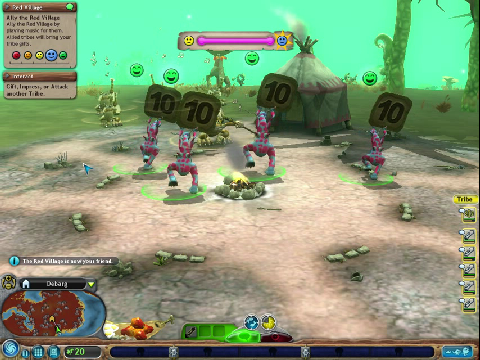
| ex3=<mt p="InGameFeedback" g="Spore" w="{{R4by3W}}" h="{{R4by3H}}"></mt> | | ex3=<mt p="InGameFeedback" g="Spore" w="{{R4by3W}}" h="{{R4by3H}}"></mt> | ||
| Line 39: | Line 40: | ||
| ex7=<mt p="InGameFeedback" g="End War" altg="Tom Clancy's EndWar" w="{{R16by9W}}" h="{{R16by9H}}">In-game reactions to voice commands ([[Sound Input]]), including the inability to understand or execute an order.</mt> | | ex7=<mt p="InGameFeedback" g="End War" altg="Tom Clancy's EndWar" w="{{R16by9W}}" h="{{R16by9H}}">In-game reactions to voice commands ([[Sound Input]]), including the inability to understand or execute an order.</mt> | ||
| ex8=<mt p="InGameFeedback" g="Papa Sangre" i=1 w="{{ViPhoneH}}" h="{{ViPhoneW}}"></mt> | | ex8=<mt p="InGameFeedback" g="Papa Sangre" i=1 w="{{ViPhoneH}}" h="{{ViPhoneW}}"></mt> | ||
| + | <!--| ex9=<mt p="InGameFeedback" g="Pond" altg="pOnd" i=1 w="{{R8by5W}}" h="{{R8by5H}}"></mt>--> | ||
}} | }} | ||
Latest revision as of 06:39, 27 August 2012

|

| |
| The card's front face | The card's back face |
Contents
Synopsis
| Providing indicators on the player's acoustic performance. |
Relationships
Contexts:
Sound Input  , Rhythm Gameplay
  , Pitch Gameplay
  , Awareness
  , Emotional Script
  .
.
Relates to:
Levelled Performance  .
.
Description
Gameplay demanding Sound Input, as in the case of Pitch Gameplay, or requiring some kind of auditory performance such as Rhythm Gameplay, may introduce unfamiliar challenges to players.
One interesting approach to deal with this is to provide in-game (diegetic) feedback and assistance. This not only presents a contextualized way to deliver Awareness to players, regarding their actions, but can also play an important role in terms of the game’s Emotional Script.
In some examples, this feedback promotes positive emotions, which may contribute to: balancing the distress of unachievement; favouring cognition by maintaining the player in a positive mood [pending:[REF]]; and, providing an additional source of entertainment.
A complementary way to tackle complexity is to let the players evolve their sound performance through stages of Levelled Performance, similarly as it is commonly done with other gameplay aspects.
Examples
    |
 |
 |
 |
 |
 |
 |
 |


